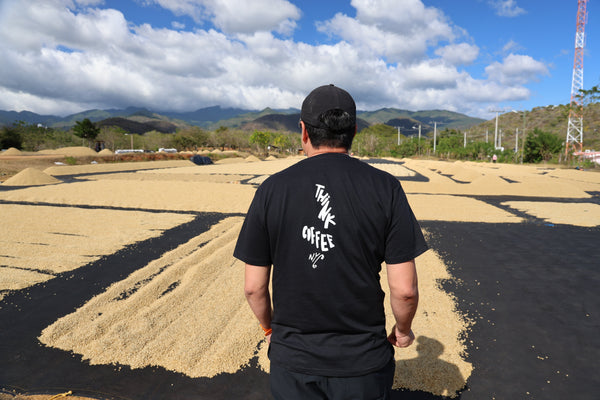
Nelson Ramirez — Finca Chely
It’s been 10 years since I’ve introduced a new country to our coffee lineup. Ten years. Not because I haven’t been looking, but because finding great coffee is actually the easier part. Finding someone you want to build a relationship with is much harder.
Thankfully, some of my closest relationships have come through other close friends. Who better to understand you and make a connection than someone who already knows you? For me, that person was Jorge Lagos, a longtime friend and coffee partner in Nicaragua. Jorge knows me. He knows how I approach coffee, what I look for in a partner and probably, by now, how difficult I can be about these things. So when I mentioned my curiosity about the Santa Bárbara region of Honduras, he told me there was someone I needed to meet: Nelson Ramirez.
I’ll admit something: I had ignored Santa Bárbara for years. I knew its reputation for specialty coffee, but unfairly assumed there was already plenty of wealth and attention there and that farmers probably didn’t need a partnership like ours. It was an assumption, and not a particularly fair one. Then I heard a conversation about the region that made me curious enough to question some of that. I called Jorge. He knew Nelson through Zamorano, the agricultural school they both attended, and even offered to drive with me from Nicaragua to meet him. What a good friend. Seven hours, a border crossing and a few food stops later—including chicharrón from a drive-thru window, which might be reason enough to return to Honduras—we arrived. Music, good food, a beautiful drive and one of my closest friends alongside me. I remember thinking, Jorge gets me.
And then we arrived in Santa Bárbara and I realized how little I knew about this place. Lake Yojoa sits beneath these massive, boulder-filled mountains covered in jungle. Jorge and I had both been to Honduras before, but neither of us had seen this part of it. It looked like Jurassic Park. We just stared at each other. I remember having that feeling you sometimes get when traveling somewhere for the first time, where everything you thought you knew about a place suddenly feels very small.

Santa Bárbara, Honduras ·
Then we met Nelson.
His farm is called Finca Chely, named after his mother, and sits on the mountain of Santa Bárbara near Peña Blanca. The influence of nearby Lake Yojoa creates this unusual combination of rain, cool hazy mornings and nights, and sunny days. Coffee matures slowly here, and Nelson can begin harvesting around the end of October and continue all the way through May. It’s an incredible environment for coffee, but beautiful land and a great climate only get you so far. The farmer still has to know what to do with it.

Nelson Ramirez. Santa Bárbara, Honduras. 02/2026
And Nelson knows his farm. He’s an agronomist, and walking with him was one of those humbling experiences where you realize just how much there is still to learn. He approaches the farm almost like its own living system, paying attention to individual parcels and how the soil, water, shade, plants and climate all affect one another. He captures rainwater, reuses water from processing and eventually turns what remains into compost and organic fertilizer that goes right back into the farm. At one point he got so deep into soil biology that my brain exploded a little. I was trying to keep up. But underneath all the science was actually something pretty simple: Nelson knows this land intimately, and he is constantly thinking about how to make it healthier, more self-sufficient and more resilient. Not because “regenerative” sounds good on a bag of coffee, but because the climate is changing and he wants this farm to have a future.
I could have left impressed by that alone. But as we kept talking, something else started to stand out. For someone who knew so much about his own farm, Nelson spent an awful lot of time talking about everyone else.
He openly shares what he has learned with producers around Santa Bárbara, including smaller farmers who don’t necessarily have access to the same resources. He invites people onto Finca Chely, shows them what he is doing and shares what has worked—and presumably what hasn’t. There wasn’t this feeling of protecting knowledge because it gave him an advantage. Quite the opposite. He seemed to understand that the mountain gets stronger when the people growing coffee around him get stronger, too.
And then there were his workers. This is where I really started paying attention. Nelson talked about fair wages, stability, incentives and creating an environment where people actually want to come to work. For a long time, people have been leaving farms and rural communities in search of better opportunities elsewhere. Nelson understands why. He also believes there should be a way to create opportunity locally, so that leaving isn’t the only path toward a better life.

Fresh harvest from Nelson’s farm. 02/2026
I’ve visited countless farms over the years and met incredibly talented producers. More and more, I see remarkable knowledge, technology and farming techniques being used to produce exceptional coffee. But too often what happens on the farm stays on the farm. The knowledge stops there. The opportunity stops there. With Nelson, I felt something different. He wasn’t just asking how to make Finca Chely successful. He was thinking about what it would take for the people around him to succeed, too.
That’s when I remember thinking: I need to work with this guy.
But don’t worry, it’s not that easy with me. I wasn’t ready to shake hands and call it a partnership. Over the years I’ve learned that people are really good with words, especially words like sustainability, community and responsibility. We use them so much in coffee that sometimes they start to lose their meaning. I’m the type who needs to see it. I’ll trust your actions before I trust your words.
So a few months later, during the peak of harvest, I came back. I wanted to see the farm when it was busy. I wanted to see the workers, the processing and whether everything Nelson had told me was actually happening when there was real work to be done. More than anything, I wanted to know whether the person I met the first time was really the person I thought he was.

Our CEO Jason in Nelson’s farm. Honduras. 03/2026
He was. There wasn’t a different Nelson waiting for me on the second trip. What you see is what you get with him. Open, honest and completely himself. Refreshing. And I think that second visit mattered more than Nelson probably realized, because that’s when admiration became trust. That’s when I knew this was someone I wanted us to grow with.

Enrique at Nelson’s farm. Honduras. 03/2026
- Enrique Hernandez
Chief Impact Officer. Green coffee buyer. Q grader