beyond the cupping table - why we go to origin to choose our coffee
-Selecting Coffees
People often imagine that selecting coffee is simple: taste a few samples, pick the best ones, and move on. The reality is much more layered than that.
In most cases, a buyer never meets the person who grew the coffee. Samples arrive through exporters or importers, decisions are made at a cupping table, and contracts follow. It works—but it creates distance.
We’ve chosen to work differently. Not because it’s easier, but because it asks more of us.
If we’re going to talk about quality, transparency, or fair pricing, then we believe those things shouldn’t live on a label—they should be witnessed, questioned, and understood firsthand. That responsibility sits with us.

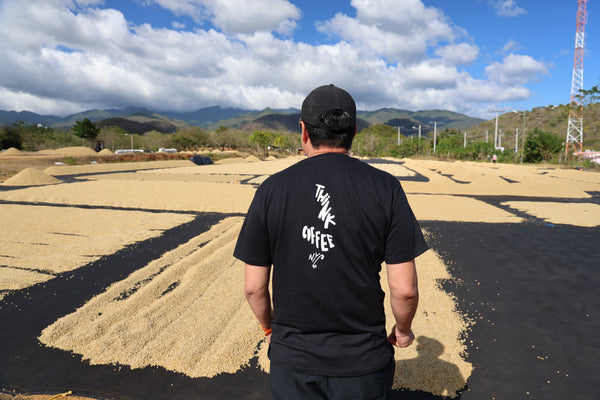
Colombia, August 2016 — one of my early sourcing trips for Think Coffee.
-Going to Origin
Every year, I travel to origin—before, during, and after harvest.
Travel itself isn’t glamorous. It’s long flights, delays, and exhaustion. But none of that really matters once you arrive.
Because this is where coffee stops being a product and becomes a place. A landscape. A community of people whose work, decisions, and livelihoods shape everything that ends up in the cup.
I spend my time walking farms, sitting with producers, and paying attention to the details that don’t show up in a sample: how the land is cared for, how workers are treated, and how decisions are made when no one is watching.
There’s one question I keep coming back to: Is what we’re paying actually making a difference here?

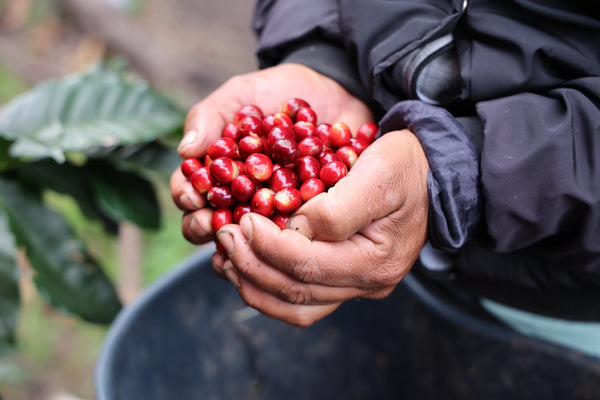
With our longtime coffee partners in Aponte, Colombia, August 2025.
-More Than Just Taste
During harvest, I cup coffees every day—sometimes dozens at a time. As a Q Grader, I’m trained to evaluate quality in a structured way. But the score is only part of the story.
A coffee can taste incredible and still come from a system that isn’t working for the people behind it.
So selection becomes a balance. The coffee has to be something our customers will love, but it also has to represent something we can genuinely stand behind.
And when a coffee isn’t quite there yet, we don’t disappear. We stay invested. We work with producers over time—adjusting processing, refining techniques, and improving consistency—so quality can grow alongside sustainability.

-Building Something That Lasts
At its core, this work is about relationships.
Not transactions or one-time purchases, but partnerships that develop over years. That means having honest conversations about price, risk, and what it actually takes to make coffee production viable over the long term.
We contract coffees directly with the people who produce them. No layers separating us. No guessing where the value is going.
That closeness brings accountability. It also brings clarity.

With one of our coffee partners Biniyam in West Guji, Ethiopia, 2024.
-The Journey to New York
Once a coffee is selected, its journey is just beginning.
It moves from the farm to the mill, where it’s prepared for export. It’s packed carefully to protect everything that’s been worked on for months—sometimes years—and then begins its journey across the ocean.
There’s a tendency to think of shipping as automatic, but it rarely feels that way. Routes change. Delays happen. Containers sit at ports longer than expected. There’s constant uncertainty in moving something this far, through so many hands and systems.
Yet that movement is part of the story. Coffee is one of the few products we consume every day that travels such great distances, carrying with it the work of entire communities.
Before it can enter the United States, it passes through U.S. Customs and Border Protection and the U.S. Food and Drug Administration—another layer of responsibility, ensuring what arrives is safe, documented, and accounted for.

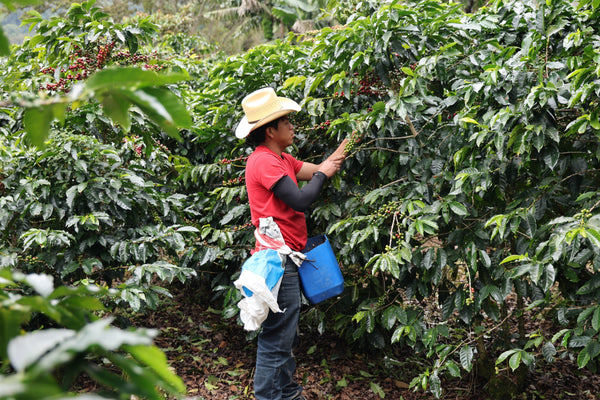
With our long term origin partner Melky Chaves in Colombia, 2026.
-Arrival
When the coffee finally reaches New York, it isn’t the end of the journey—it’s a transition.
It moves into a warehouse, rests, and waits. From there, it will be roasted, brewed, and eventually served.
What ends up in the cup is the final expression of everything that came before it: the farming, the decisions, the risks, the travel, and the waiting.

Green coffee arriving at our Devoe Street Roastery in Brooklyn, fresh from origin.
-Why It Matters
It would be easier to stay at a cupping table and make decisions from a distance. Many do.
But we believe that if we’re going to serve something people trust and return to every day, then we should be willing to carry more of the responsibility behind it.
So when you drink our coffee, you’re not just tasting something we selected.
You’re tasting a chain of choices. A network of relationships. A commitment to being present—not just at the end, but at every step along the way.
-Enrique Hernandez, Green Coffee Buyer