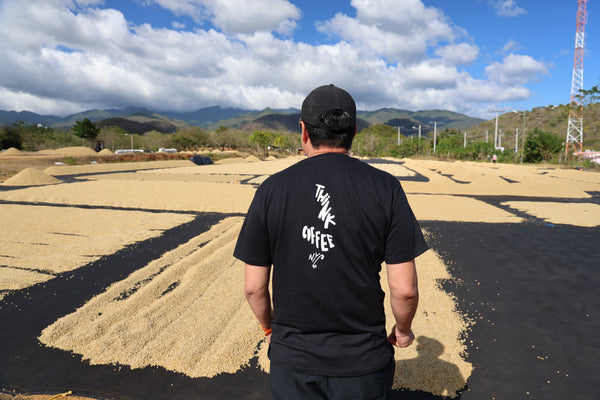
coffee isn’t just a drink—it’s a fruit.
It starts as a cherry grown on trees across the “coffee belt,” a band of tropical regions circling the globe. Dozens of countries produce coffee—some world-famous, others under the radar—but all are part of a supply chain that fuels billions of cups every day.
In the industry, we call these producing regions origin. That’s where coffee is grown, harvested, and first processed—and where our Green Buyer travels to source coffees directly. Which brings us to one of the most talked-about terms in specialty coffee: single origin.
Single origin coffee means exactly what it sounds like—coffee from one place. That “place” can vary in scale: a single farm, a specific lot, a cooperative, or an entire region. You might have a mixed-varietal coffee from one estate (like Santa Isabel), a tiny microlot (Santa Teresa), or a co-op harvest from a village in Ethiopia. Different structures, same idea: one defined origin, one distinct expression of flavor.
At Think Coffee, we import our coffees ourselves. Our Green Buyer selects standout single origins at origin, and they make their way to Brooklyn, where we roast and develop profiles for our lineup—Santa Isabel, Java, Parainema, El Páramo, and more.

El paramo is one of our single origin coffees cultivated by our long term partners, smallholder farmers in Aponte, Colombia.
These coffees aren’t just featured on their own—they’re also the building blocks of something else: blends.
A blend combines two or more single origin coffees to create a balanced, consistent, and often more versatile cup. Take our Devoe Blend: coffees from Nicaragua and Colombia working together to hit a specific flavor target.
Blending isn’t random—it’s craft. Roasters consider flavor notes, processing methods, seasonality, and how a coffee performs across brew methods. Done well, a blend is more than the sum of its parts.
So next time you take a sip, don’t just taste coffee—taste where it came from.
– Jason Scherr, Founder & CEO